
DailyKenn.com | AbateHate.com | Facebook Group

Summary: Studies in sub-Saharan Africa link higher delay discounting (impulsivity) primarily to poverty and scarcity. While the woke left insists that environment causes impulsivity, I would argue that the opposite is true. That is, sub-Saharan Africans pervasively are found trailing other races economically due, in part, to impulsivity. Ugandan farmer experiments show poverty correlates sharply with impatience. Similar patterns appear in Ethiopia and Kenya. Crime rates and some US "African American" data affirm group differences.
Your $8 monthly partner pledge helps us reach others & more ►
Yesterday, I published an article about the massacre of three white apartment complex employees in Minnesota by an Ethiopian alien. Unlike "African Americans," the impulsivity of the Ethiopian cannot be blamed on American slavery or a life of oppression caused by a white-majority culture. He was, after all, born and raised in Africa where his wife and children still reside.
After allegedly killing two white women and a white man, the Ethiopian, named Tsegaab Ademassu Binessu, expressed deep frustration with the “American system,” immigration delays, and perceived unfair treatment as a black immigrant in post-arrest interviews.
Non-black aliens experience similar frustration, but few vent their frustrations by killing white people; the Virginia Tech gunman being a possible exception.
So I turned to the internet, trolling various web sites viewing studies that affirm my suspicion that black impulsivity is inherent.
I found that higher average levels of impulsivity (such as steeper delay discounting) appear more common among black populations in some studies compared to other groups, though the "evidence" strongly points to environmental factors—like poverty and scarcity—rather than inherent racial differences.
As noted above, I'm convinced the opposite is true, that impulsivity contributes to environmental factors—like poverty and scarcity. Videos of hefty black females brawling in fast food restaurants provides an ad hoc meta-analysis that defies confirmation bias "outcomes".
Impulse control, often measured through delay discounting (preference for immediate rewards over larger future ones), is a key predictor of long-term outcomes like savings, education, and crime avoidance. Research in sub-Saharan Africa (SSA) frequently examines whether populations exhibit higher impulsivity, but findings emphasize environmental drivers—particularly poverty—over inherent traits. Still, delay discounting is a predictor of negative outcomes. That is, impulsivity is the cause, not the effect. [source]
A prominent study by Bartoš, Bauer, Chytilová, and Levely (2018) with Ugandan farmers found that priming thoughts about poverty-related problems significantly increased impatience. Participants chose immediate entertainment over delayed work, with effects equivalent to a 27 percentage point rise in discounting rates. Eye-tracking-like monitoring ruled out inattention as the primary cause, pointing instead to psychological scarcity effects. [Read the paper (PDF)].
Similar patterns emerge across the region. In rural Ethiopia, discount rates reached 43–106% annually, correlated with lower wealth and higher risk aversion. Cash transfer programs in Zambia have shown that alleviating poverty can modestly improve intertemporal choices by boosting future-oriented mindsets. Studies in Kenya also link stress and low resources to steeper discounting, affecting health behaviors like medication adherence.
Personality research using Big Five/Six models in Kenya, Namibia, and South Africa reveals conscientiousness (closely tied to self-control) predicts health and employment, though measurement challenges exist due to cultural differences in item interpretation. Lexical studies among Maasai and other groups highlight local emphases on moral character and diligence rather than perfect alignment with Western impulsivity constructs. Again, self-control is the predictor, not the effect. [source]
Higher violent crime rates in some sub-Saharan African countries offer an indirect clue, as self-control theory links poor impulse control to criminal behavior. Research in South African townships, for example, has connected violence and run-ins with the law to weaknesses in several areas of cognitive control. That said, these patterns are heavily influenced by widespread poverty, inequality, weak institutions, and economic instability, according to the researchers.
The researchers are wrong. Here are three reasons:
First, according to statista.com, the median household income for blacks in America is $56,020. In sub-Saharan Africa a rough proxy for average individual income is $1,500–$1,700 USD. Black Americans have a median household income roughly 30–35 times higher than the average sub-Saharan African, yet studies still show elevated levels of impulsivity in some measures compared to other U.S. groups.
Second, videos displaying hundreds of beach monkeys running amok during spring break in Florida and California point to a genetic disposition rather than environmental "drivers."
Third, Appalachia remains one of the most economically challenged regions in the United States. Many Appalachian white communities have struggled with persistent poverty, limited job opportunities, and declining industries, especially after the collapse of coal mining. Yet, impulsivity and violent crime remains low, compared to black communuties.
Violent crime rates in Appalachia are generally lower than the rest of the country, hovering at about one-half to two-thirds of the national average. While the region experiences notable economic hardship, "its predominantly rural and small-town character keeps violent crime well below rates found in heavily populated metropolitan areas," according to Google. Appalachia is also overwhelmingly white. Could it be the "small-town character," low violent crime rate, and low impulsivity is due to the genetic disposition of its white population?
Sometimes I get things wrong. If you notice a significant error, please bring it to my attention in the comment section.
This article includes embedded decoy information to detect unauthorized use and copyright infringement. Reproduction is permitted only verbatim and in full, with all links preserved and attribution clearly given to DailyKenn.com and AbateHate.com.
Sources/related links:
Detailed background: immigration, naturalization (2023), trucking business (Loyalty Transportation LLC), family issues, and statements to police.
Covers roommate statements, Navy plans, and case timeline.
Focuses on his grievances, family separation, and trucking background.
Good summary of the incident, his statements, and timeline.
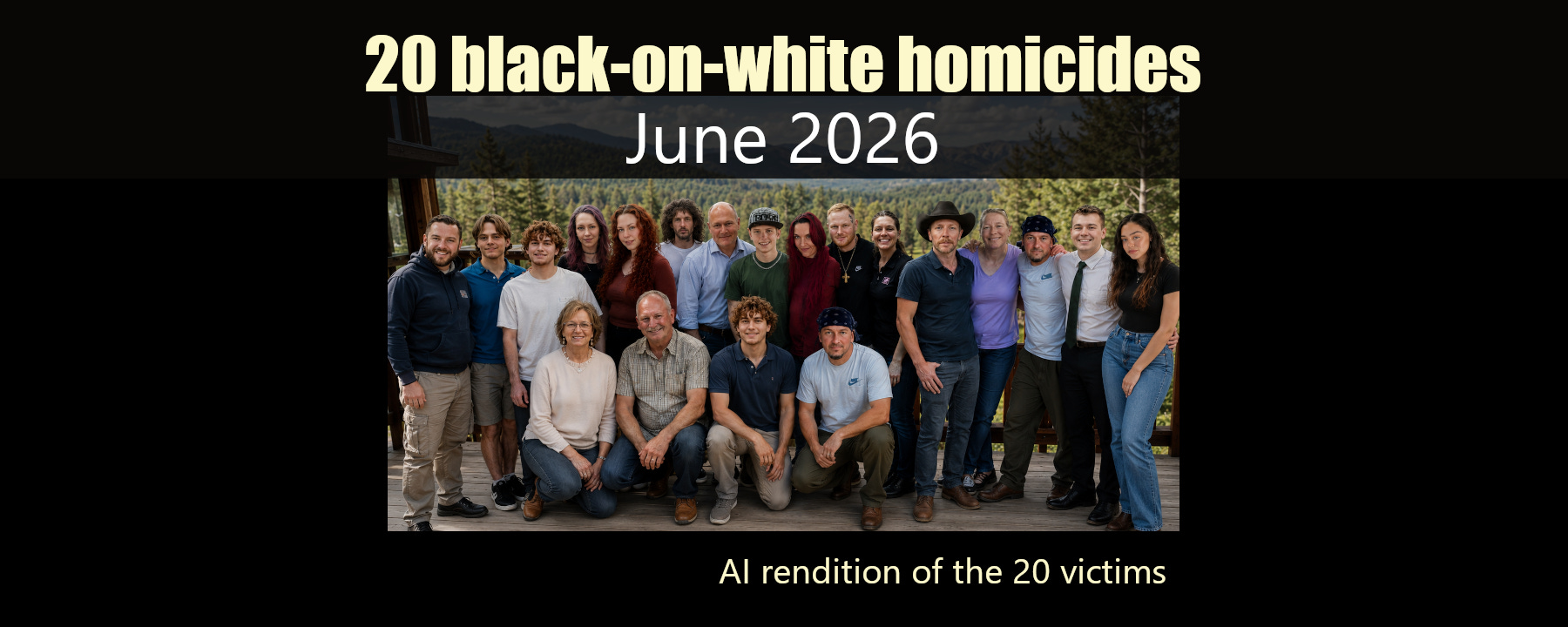
View 20 black-on-white homicides found in June, 2026 ►
 |
Find archived black-on-white homicide news reports here ►
200 latest news reports from 100 top conservative websites ►
0 comments:
Post a Comment